
Why storage matters for gaming avatars
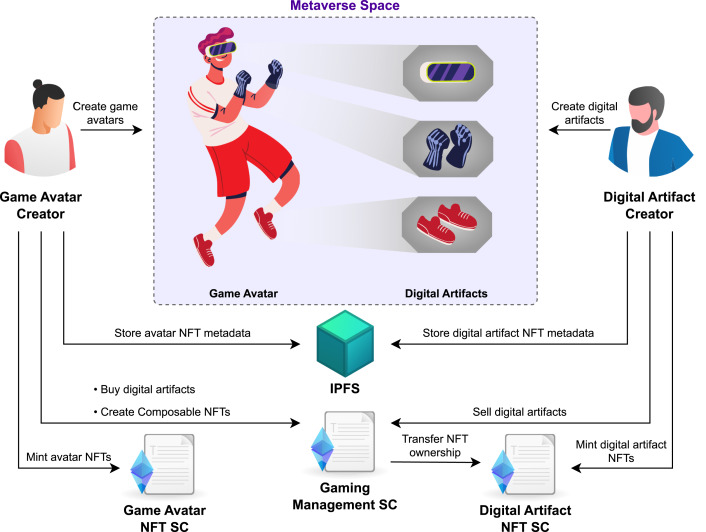
When you look at a gaming NFT avatar, you are seeing a token on a blockchain that points to a digital file. The way that file is stored determines whether your avatar survives the test of time or vanishes when a server shuts down. This distinction between onchain metadata and IPFS storage is the difference between a temporary collectible and a permanent gaming asset.
Onchain metadata lives directly on the blockchain ledger. It is immutable and decentralized, meaning no single company can alter or delete the record. However, blockchains are expensive places to store large files. Storing the actual image of a high-resolution avatar on-chain would cost hundreds of dollars in gas fees. Instead, the blockchain typically stores a pointer—a URL—directing your wallet to where the image is hosted.
This is where IPFS (InterPlanetary File System) becomes essential. IPFS is a peer-to-peer network that distributes files across many computers rather than storing them on a single centralized server. If you host your gaming NFT avatar on a traditional web server and that company goes out of business, your avatar’s image link breaks. With IPFS, the file persists as long as someone in the network pins it. This ensures that gaming projects like Parallel or CloneX remain accessible and functional regardless of what happens to the original developers.
The goal is to combine both technologies. By storing the metadata on the blockchain, you prove ownership and authenticity. By storing the actual image and traits on IPFS, you ensure the visual data is available forever. This hybrid approach is why gaming NFT avatars built on this infrastructure are considered more robust and valuable for long-term utility.
Parallel Avatars: AI-Driven Gaming Utility
Parallel Avatars stands out as a prime example of gaming NFT avatars designed for actual gameplay rather than static display. These are not just profile pictures; they are handcrafted AI agents intended to function within the upcoming title Parallel Colony and a third-person shooter project centered around the Parallel universe.
The collection leverages IPFS and onchain metadata to ensure these digital identities remain portable and verifiable across different game environments. By storing the underlying data on decentralized networks, Parallel ensures that the AI agents retain their unique attributes and history, providing a persistent identity for players even as the games themselves evolve. This approach moves beyond simple ownership, offering a functional utility that integrates directly into the mechanics of the planned titles.
For collectors, this represents a shift toward utility-first assets. Instead of holding a JPEG that sits in a wallet, owners hold an AI agent ready to participate in immersive gaming experiences. As Parallel continues to develop its ecosystem, these avatars serve as the foundational identity layer for players entering its sci-fi narrative.
Reddit avatars: social proof on Polygon
Reddit recently rolled out NFT avatars on the Polygon network, shifting the focus from speculative trading to community reward mechanics. Unlike traditional profile pictures, these on-chain assets serve as verifiable badges of user activity and engagement within the platform’s subreddits. By leveraging Polygon’s low fees and high throughput, Reddit has made it feasible to distribute these gaming NFT avatars to a massive user base without the gas costs that typically plague Ethereum mainnet.
The distribution model is currently opaque, with reports suggesting an eligibility criteria based on specific user behaviors rather than a public mint. Early adopters noted that the rollout appears limited to Android devices, creating a tiered access system that prioritizes active participants. This approach transforms the avatar from a static image into a dynamic proof of participation, allowing users to display their history and contributions directly in their profile metadata.
CloneX and Yuga Labs: Premium digital identity
CloneX stands as a benchmark for high-fidelity gaming NFT avatars, leveraging the production value of Yuga Labs and the artistic direction of RTFKT. Unlike many profile pictures that rely on static 2D images, CloneX avatars are built with robust 3D assets, making them ideal for cross-platform identity usage in virtual worlds and gaming environments.
The collection’s technical backbone prioritizes onchain metadata and IPFS storage, ensuring that the intricate details of each avatar—from skin textures to clothing layers—remain accessible and verifiable. This approach aligns with the growing demand for gaming NFT avatars that offer genuine utility beyond simple social media display, allowing holders to use their assets in compatible metaverse applications.
Storage and metadata standards compared
When evaluating gaming NFT avatars, the underlying infrastructure determines how long your asset lasts and how easily it integrates with modern wallets. While some projects rely on centralized servers that can vanish, others use decentralized storage or on-chain data to ensure permanence. This comparison looks at three distinct approaches: Parallel’s on-chain transparency, Reddit’s account-linked structure, and CloneX’s hybrid IPFS model.
| Project | Storage Method | Primary Network | Primary Use Case |
|---|---|---|---|
| Parallel Avatars | On-chain (ERC-6551) | Polygon | In-game identity & deck building |
| Reddit Avatars | Centralized (Account-bound) | Polygon | Community verification & access |
| CloneX | IPFS + Metadata JSON | Ethereum | Metaverse wearables & PFPs |
Verify IPFS pins before buying
Purchasing gaming NFT avatars like Parallel Avatars or Reddit’s Polygon-based profiles is only as secure as the storage backing them. If the underlying IPFS pin drops, your avatar becomes a broken link, regardless of what the blockchain says. Treat this verification step as your final quality check before transferring funds.
Locate the metadata URI in the token’s on-chain data. This string usually starts with ipfs://. Copy the hash portion and paste it into a public gateway like ipfs.io/ipfs/<hash> to confirm the file loads correctly.
Use a pinning service dashboard (like Pinata or Infura) to check if the hash is actively pinned. A "pinned" status ensures the data is replicated and won't disappear if the original uploader goes offline.
Open the JSON file from the gateway. Ensure it contains the image URL and any gaming-specific attributes (like wearables or stats). If the JSON is empty or points to a 404 error, the asset is incomplete.


As an Amazon Associate, we may earn from qualifying purchases.

No comments yet. Be the first to share your thoughts!